
For professional towing companies, equipment decisions directly impact safety, efficiency, and profitability. One of the most common comparisons operators and owners evaluate is tow dolly vs flatbed. Both serve important roles in modern towing, but understanding when and why to use each is critical—especially as vehicles become heavier, more complex, and more sensitive to improper transport methods.
At Collins Manufacturing, we work with towing professionals every day who are navigating these decisions. The goal isn’t to declare one method universally better than the other. Instead, it’s about choosing the right tool for your operation, your service area, and the types of vehicles you handle most often.
 Understanding the Basics: Tow Dolly vs Flatbed
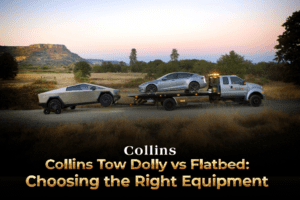
A flatbed tow truck transports a vehicle fully off the ground on a hydraulic platform. This method offers full vehicle support and is often used for long-distance transport, severely damaged vehicles, or specialty recoveries.
A tow dolly, such as a Collins Hi-Speed® Dolly, supports a vehicle’s wheels during transport, creating a stable and controlled towing setup. Designed for professional recovery work, Collins tow dollies are engineered for durability, efficiency, and operator-friendly performance in real-world conditions.
When evaluating tow dolly vs flatbed, the question isn’t which is “better” overall—it’s which solution aligns best with your operational demands.
Vehicle Complexity and Modern Towing Demands
Modern vehicles present new challenges for towing companies. Electric vehicles (EVs), all-wheel drive (AWD) systems, hybrid drivetrains, and advanced electronic components require careful handling. Improper towing can lead to drivetrain damage, warning system malfunctions, or costly liability issues.
Flatbeds offer full vehicle isolation from the roadway, which can be beneficial for certain vehicle types and severe accident recoveries. However, tow dollies provide versatility and efficiency for many standard recovery situations while maintaining stability and control during transport.
For many operations, the real decision in the tow dolly vs flatbed discussion comes down to frequency of use and operational efficiency.
Operational Efficiency and Scene Clearance
Time is money in towing. Faster loading and unloading can mean clearing accident scenes more quickly, reducing operator exposure to traffic, and completing more calls per shift.
Tow dollies are often valued for their ability to support efficient recovery operations, especially in high-volume service environments. When properly deployed, a dolly setup can streamline the process of securing and transporting a vehicle without requiring a full flatbed configuration.
Flatbeds, while highly versatile, can require more space to maneuver and operate—particularly in tight parking lots, congested streets, or confined roadside environments.
For towing business owners evaluating tow dolly vs flatbed, consider how often your team works in space-restricted conditions and how quickly you need to turn calls.
Versatility Across Call Types
Most professional towing companies handle a mix of service calls:
- Roadside assistance
- Accident recovery
- Disabled vehicle transport
- Dealership and repair shop deliveries
- Impounds and relocations
Flatbeds are highly effective for severely damaged vehicles or when full vehicle isolation is required. However, tow dollies can provide flexibility for a wide range of routine and moderately complex recoveries.
Many successful operations don’t treat tow dolly vs flatbed as an either/or decision. Instead, they evaluate how each tool supports different job types and build a fleet strategy that balances capability with efficiency.
Safety and Risk Management
Operator safety and vehicle protection are top concerns for towing company owners and managers. Roadside work exposes operators to traffic hazards, uneven terrain, and unpredictable conditions.
Flatbeds provide a fully elevated transport method, which can reduce certain risks depending on the scenario. Tow dollies, when engineered for professional use, offer stable tracking and controlled handling during transport, supporting safe operation across varied road conditions.
From a liability perspective, the real consideration in the tow dolly vs flatbed comparison is whether your equipment supports consistent, controlled, and predictable vehicle movement.
Cost, Investment, and ROI
Capital investment plays a major role in equipment decisions. Flatbed trucks represent a significant financial commitment, often justified by versatility and full-service capability.
Tow dollies, on the other hand, can provide cost-effective versatility that supports a wide range of recovery scenarios without requiring a full additional vehicle investment. For companies managing labor shortages, rising fuel costs, and tight margins, equipment efficiency and long-term durability matter.
When weighing tow dolly vs flatbed, owners should consider:
- Frequency of severe recovery calls
- Average vehicle types handled
- Operational environment (urban, rural, highway-heavy)
- Budget and long-term equipment planning
Often, the most strategic decision isn’t eliminating one option—but determining how each fits within a broader fleet strategy.
When a Tow Dolly Makes Strategic Sense
A Collins tow dolly may be a strong choice when:
- You need efficient solutions for high-volume daily calls
- Space constraints limit flatbed maneuverability
- You want to enhance operational flexibility
- You’re looking to expand capability without adding a full truck investment
Professional-grade dollies are engineered to support safe, stable towing while allowing operators to work efficiently in real-world conditions.
When a Flatbed May Be the Right Fit
A flatbed may be preferred when:
- The vehicle is severely damaged
- Full off-ground transport is required
- Long-distance hauling is common
- Specialty or exotic vehicles require maximum isolation
Understanding these distinctions helps towing professionals move beyond the simplistic tow dolly vs flatbed debate and instead focus on strategic deployment.
Making the Right Equipment Decision for Your Operation
The modern towing landscape requires adaptability. Vehicle technology is evolving, customer expectations are rising, and operational pressures are increasing.
Rather than viewing tow dolly vs flatbed as a competition, professional towing companies should evaluate how each solution supports safety, efficiency, profitability, and long-term growth. Collins Manufacturing designs its towing equipment to meet the real demands of the field—helping operators and owners make confident equipment decisions based on performance, reliability, and operational value.
Ultimately, the right equipment strategy is the one that allows your team to respond quickly, transport vehicles safely, and protect your business on every call. Our team at Collins can help you decide on the best towing equipment for your operations. Contact us today to learn more about our Hi-Speed® Dollies and Carrier Dollies.
Leave a Reply