
No two towing companies handle the exact same mix of vehicles, routes, and recoveries. That means that in order to choose the right Collins tow dolly models for your fleet, you have to understand which vehicles your operators tow most often, how much capacity they need, and where they need to travel. Our Hi-Speed® dolly lineup gives towing companies several configurations to match different operating demands, and our Carrier Dolly provides a specialized solution for loading vehicles onto flatbeds. Understanding the differences in our tow dollies helps you invest in the equipment that makes the most sense for your fleet.
Which Collins Tow Dolly Model Is Right For Your Towing Fleet?
Choosing the right Collins tow dolly depends on vehicle weight, tire size, cross rail requirements, operating speed, and the type of towing your fleet performs. G7 Hero, Pro, and Repo configurations offer different combinations of capacity, cross rails, wheels, and tires, while the G7X offers an industry-leading 5,000-lb capacity and a 75-MPH speed rating for demanding applications.
What Should You Compare When Choosing a Tow Dolly?
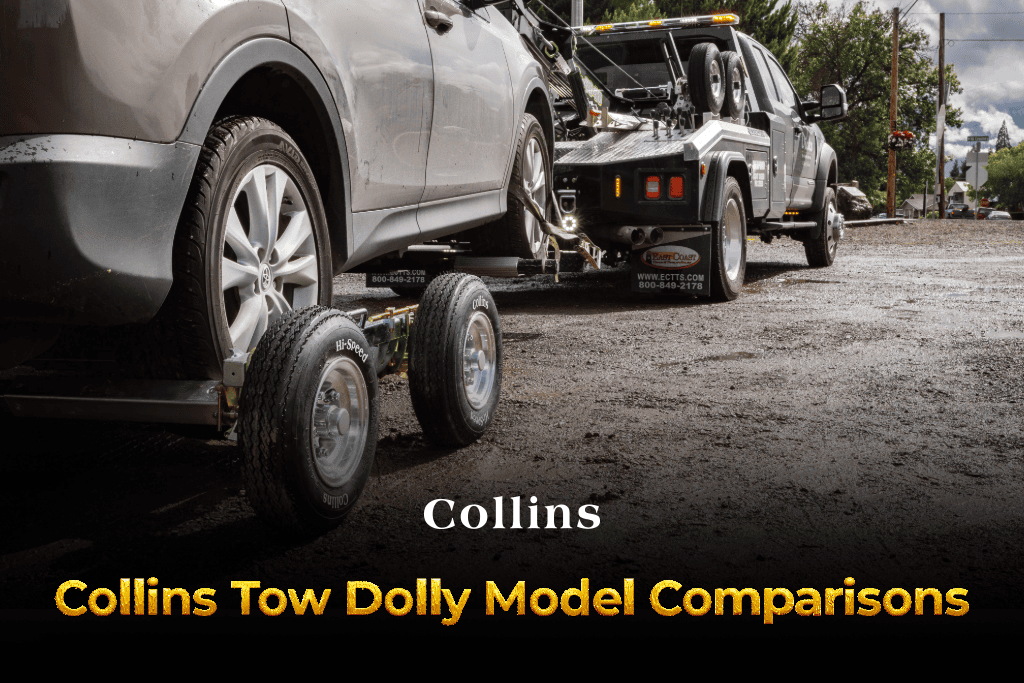
Before comparing individual tow dolly models, consider the jobs your operators perform every day. A fleet that primarily handles passenger cars has entirely different needs than a company that regularly encounters heavier vehicles or travels long distances.
We recommend evaluating:
- Load capacity: Make sure the dolly can safely support the vehicles your fleet expects to tow.
- Tire size and load rating: Collins G7 configurations offer 4.80×8 and 5.70×8 tire options with different load ratings.
- Cross rails: G7 models use aluminum T10 or wider T12 cross rails, depending on the configuration.
- Wheel construction: Hero and Pro models use aluminum wheels, while Repo and G7X configurations use steel wheels.
- Operating speed: G7 models carry a 65 MPH speed rating, with the G7X at an industry-leading 75 MPH rating.
- Vehicle mix: Consider how frequently your operators encounter heavier EVs, AWD vehicles, low-clearance vehicles, luxury vehicles, and vehicles with damaged or locked wheels.
How Do Collins G7 Hero Tow Dolly Models Compare?
The Collins G7 Hero configuration pairs aluminum construction with T12 cross rails and two tire options.
- G7 H5D: 5.70×8 D-rated tires, aluminum T12 cross rails, aluminum hubs and wheels, 4,280-pound capacity, and 65-MPH speed rating
- G7 H4D: 4.80×8 D-rated tires, aluminum T12 cross rails, aluminum hubs and wheels, 3,968-pound capacity, and 65-MPH speed rating
The H5D gives fleets more capacity, making it the stronger choice when heavier vehicles regularly appear on the dispatch board. However, the H4D isn’t far behind with nearly 4,000 pounds of capacity and a smaller tire configuration.
Cross rails are the biggest differentiator between our G7 Hero configurations and G7 Pro and Repo models. The Hero configurations feature wider T12 cross rails, making them worth a closer look for fleets seeking greater stability.
When Does a Collins G7 Pro Tow Dolly Make Sense?
The G7 Pro offers fleets several capacity options, including aluminum T10 cross rails, hubs, and wheels. We’ve found that flexibility makes it easier to match your equipment investment to your typical vehicle mix.
- G7 P5D: 5.70×8 D-rated tires and 4,280-pound capacity
- G7 P4D: 4.80×8 D-rated tires and 3,968-pound capacity
- G7 P4C: 4.80×8 C-rated tires and 3,040-pound capacity
The P5D provides the group’s highest capacity, while the P4C works well for operations that primarily handle lighter vehicles and don’t need the additional capacity of a D-rated setup. All three configurations carry a 65 MPH speed rating.
Who Should Consider a Collins G7 Repo Dolly?
Like the Collins G7 Hero and Pro tow dolly models, the G7 Repo models use aluminum T10 cross rails and aluminum hubs, but the wheels are steel. Current configurations include:
- G7 R5D: 5.70×8 D-rated tires, steel wheels, 4,280-pound capacity, and 65 MPH speed rating
- G7 R4D: 4.80×8 D-rated tires, steel wheels, 3,640-pound capacity, and 65 MPH speed rating
For fleets comparing our Hero, Pro, and Repo models, wheel construction is the biggest difference. The Repo line features steel wheels instead of aluminum. However, that’s not the only difference in these dolly models. That’s why it’s important to compare all the specs when choosing the right equipment for your fleet.
When Should a Fleet Step Up to the G7X Hi-Speed® Dolly?
Some towing operations need more than the standard G7 lineup provides. That’s why we created the G7X Super Dolly®. Engineered for Canada’s harsh winters, the G7X increases capacity to an industry-leading 5,000 pounds and raises the speed rating to 75 MPH. It’s built with 5.00×8 E-rated tires, T12 Hybrid cross rails, steel hubs, and steel wheels. The complete set comes in at 228 pounds.
Those specs make the G7X worth considering when your fleet regularly encounters heavier vehicles or needs greater capacity. As modern vehicles add weight from EV battery packs, AWD systems, and other technology, towing companies need to ensure their equipment can handle the loads their operators encounter.
Don’t buy maximum capacity just because the number looks good on paper, though. It’s far better to match capacity to your fleet’s actual needs, operating procedures, and expected vehicle mix.
When Is the Collins Carrier Dolly the Better Solution?
A Hi-Speed® Dolly and a Carrier Dolly solve different towing challenges. The Collins Carrier tow dolly models focus on getting difficult vehicles onto a flatbed by allowing them to roll rather than be dragged.
The standard CD-S Carrier Dolly System includes one pair of aluminum Carrier Dollies, tie-down straps, an aluminum tow bar, bed ramps, a zinc-plated steel pry bar, and an aluminum motorcycle hook adapter. Coming in at 79 pounds, the system provides 2,000 pounds of capacity per dolly for a total of 4,000 pounds of load capacity.
For fleets that need four dollies, the CD-QS Standard Carrier Dolly Quad System includes two pairs of dollies and provides a total capacity of 8,000 pounds.
The system prevents hooks, chains, and cables from contacting the vehicle during loading, applying winch force to the dollies instead. In our experience, this makes the Carrier Dolly a good choice when operators frequently encounter:
- Low-clearance vehicles
- Vehicles with locked or damaged wheels
- Vehicles without a safe place to hook
- Electric and AWD vehicles
- Luxury vehicles that demand careful handling
- Motorcycles and other specialized loading situations
Should Your Fleet Carry More Than One Type of Collins Dolly?
For many towing companies, the real question is: which tow dolly combination prepares your fleet for the calls they actually receive?
A G7 Hi-Speed® Dolly supports everyday towing and transport requirements, while a G7X adds capacity for more demanding jobs. Meanwhile, a Carrier Dolly gives operators another tool when a low-clearance, locked-wheel, luxury, electric, or AWD vehicle needs to be loaded onto a flatbed.
That versatility is becoming more important as the vehicles on the road change. Equipping your operators for several scenarios reduces roadside improvisation and creates more consistent towing procedures. That, in turn, reduces damage claims and improves operator safety.
How Can You Choose the Best Tow Dolly Models for Your Fleet?
Start by looking at your dispatch history. Consider the vehicles your team tows, where your operators travel, and which jobs create the biggest equipment challenges.
- Review your common vehicle weights. Determine how much dolly capacity your typical jobs require.
- Identify difficult vehicle categories. Track EV, AWD, luxury, low-clearance, and damaged-wheel calls.
- Consider your routes. Evaluate the speeds and distances your operators routinely travel.
- Compare tire and cross rail configurations. Match those specs to your expected applications.
- Think about operator handling. Weight, ergonomics, maintenance, and standardized procedures all affect day-to-day efficiency.
- Plan for tomorrow’s fleet. Choose equipment that can handle the types of vehicles your company expects to see more frequently.
Build a Better-Equipped Towing Fleet With Collins Dollies
The right towing equipment gives your operators confidence on every call. Our Collins Hi-Speed® and Carrier tow dolly models provide fleets with the capacity, tire size, cross-rail design, wheel construction, and operating speed they need to safely handle every recovery. Contact your authorized dealer to choose the right configuration for your operation.
Frequently Asked Questions
What is the difference between Collins G7 Hero, Pro, and Repo tow dollies?
Collins G7 Hero, Pro, and Repo models differ mainly in cross rail size, wheel construction, tire options, and load capacity. Hero models use T12 cross rails and aluminum wheels, Pro models use T10 cross rails with aluminum wheels, and Repo models use T10 cross rails with steel wheels.
Which Collins tow dolly has the highest capacity?
The Collins G7X Hi-Speed® Dolly is the highest capacity Collins dolly, with a 5,000-pound capacity and a 75 MPH speed rating. It also uses E-rated tires and T12 Hybrid cross rails for more demanding towing applications.
What is a Collins Carrier Dolly used for?
The Collins Carrier Dolly helps operators load difficult vehicles onto a flatbed without dragging them. It can help with low-clearance vehicles, locked or damaged wheels, electric and AWD vehicles, luxury vehicles, and other situations that call for controlled, damage-free loading.